Dealing with cyber security and AI
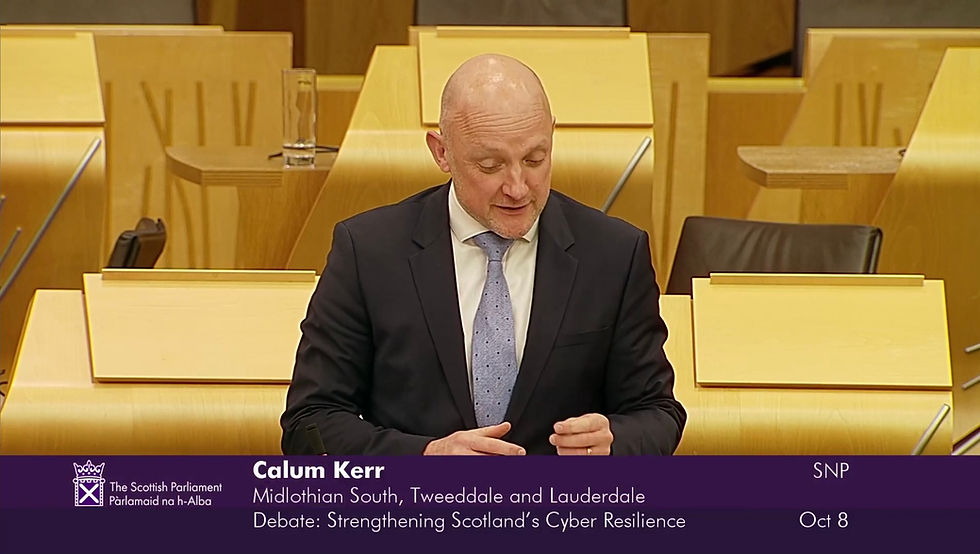
JUST before recess, I spoke in Holyrood’s debate on Scotland’s cyber resilience.
Before politics I spent 28 years working in technology, and I’ve seen what a cyber attack can do to a business and the people who rely on it.
Artificial intelligence (AI) is already changing cyber security, for better and worse.
In the debate I described AI as an accelerator. An attacker can now test thousands of weaknesses in the time it once took to test one, but the same speed is also available to the defender.
Last week we saw that in action. On October 20, researchers warned of two serious flaws in PHP, the programming language behind many of the world’s websites.
The flaws had been there for over a decade and were found with the help of AI. Fixes came out the next day, and government websites across Europe were briefly taken offline while they were updated.
The fixes came quickly, but attackers were already trying to exploit the flaws, and some have since succeeded. Speed now matters on both sides.
Working across parties
There will be more episodes like this, and it further emphasises why I believe there is a need for a Cross-Party Group on AI and Cyber at Holyrood.
I’m setting one up this week, with the Cyber and Fraud Centre Scotland providing the secretariat.
The group will bring MSPs together with people from technology, business, academia and community organisations, so we better understand how AI is developing and what it means for communities across Scotland.
We’ll look at cyber resilience, what AI means for jobs, how it can be used safely, and how Scotland can have more say over the technology and data we depend on.
Parliament needs to understand these changes well enough to ask the right questions and make good decisions.
What can you do?
The most common cyber attack is still phishing, where a fake email or text tries to trick you into handing over details or clicking a link.
The UK Government’s latest Cyber Security Breaches Survey found that 38 per cent of businesses and a quarter of charities reported phishing attempts in the past year. AI is making these attacks faster, cheaper and more convincing.
The simplest protection is two-step verification, where logging in needs something as well as your password.
The National Cyber Security Centre recommends starting with your email account. If someone gets hold of your password, that extra step makes it much harder for them to get in.
Any form of two-step verification is better than none. Avoid having the code sent to the same email account you’re protecting, as it won’t help if that account is the one taken over.
A text to your phone or an authenticator app, such as Google Authenticator or Microsoft Authenticator, both work well.
You can forward suspicious emails to report@phishing.gov.uk. The National Cyber Security Centre website, ncsc.gov.uk, has guides to setting up two-step verification on common accounts.